
Mechanical/Intermediate
For a force perpendicular to a lever, torque magnitude is force × distance from the pivot. A 20 N force at 0.25 m produces 5 N·m.
At other angles, use only the perpendicular component: torque = r × F × sin(angle). A force directed along a lever toward its pivot produces no torque about that pivot.
For a stationary ideal lever, opposing torques balance. Doubling the effort arm can halve the effort force for the same load torque. A longer lever trades movement distance for force; it does not create energy.
Put it into practice
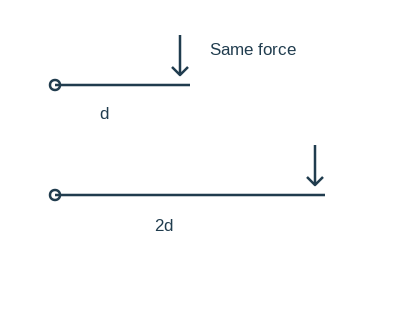
MechanicalBasic
A longer handle
You apply the same perpendicular force at twice the distance from a pivot. What happens to the torque magnitude?
Take challenge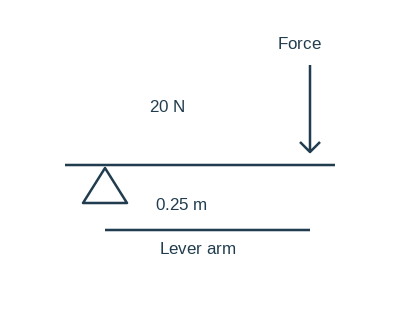
MechanicalIntermediate
A measured turning effect
A 20 N force acts perpendicular to a lever at 0.25 m from the pivot. What torque does it produce?
Take challenge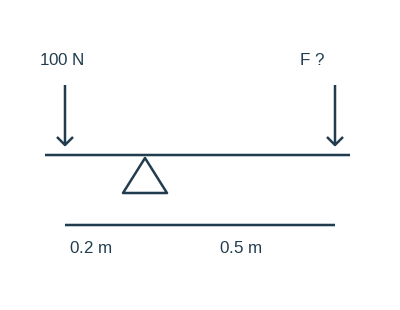
MechanicalIntermediate
Balance the lever
An ideal lever holds a 100 N load 0.2 m from its pivot. What perpendicular effort force at 0.5 m balances it?
Take challenge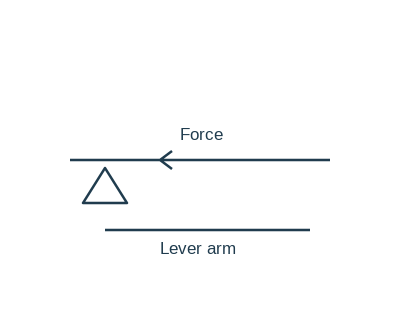
MechanicalAdvanced
A force through the pivot
A force acts along a straight lever, directed toward its pivot. What torque does this force produce about that pivot?
Take challenge
References
Original explanations based on these educational references. Reviewed 23 November 2026.
All lessons