
Mechatronics/Intermediate
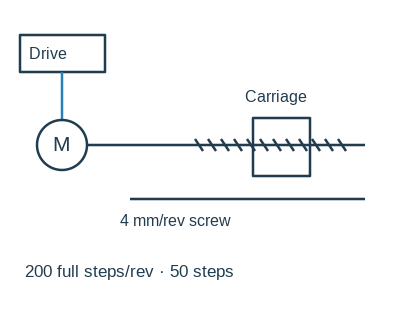
For a direct-driven screw, ideal travel equals shaft revolutions multiplied by screw lead. Divide full-step count by the motor’s full steps per revolution first. Do not silently substitute microsteps, pitch, or a different gear ratio. The problem must specify how the controller counts motion.
For an encoder on a belt roller, counted fraction of a revolution multiplied by roller circumference gives ideal belt travel. This assumes no belt slip and no missed counts. A stated count-per-revolution already includes the chosen decoding convention; do not multiply it again.
An electric actuator connected to a lever must also satisfy mechanical relationships. At a stated static position, perpendicular force multiplied by lever arm is torque. Balance opposing torques to find the supported load, while recognizing that real friction and actuator force over stroke can change the result.
Put it into practice
MechatronicsIntermediate
Pulses into travel
A stepper uses 200 full steps per revolution and directly drives a screw with 4 mm lead per revolution. With no missed steps, backlash, or slip, how far does the carriage move after 50 full steps?
Take challenge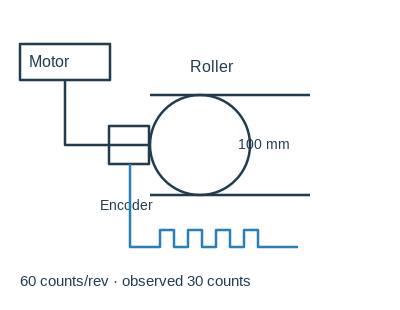
MechatronicsIntermediate
Count the roller movement
A motor-driven roller has a 100 mm circumference. Its encoder is configured for 60 counted pulses per roller revolution. With no slip or missed counts, how far does the belt move during 30 counted pulses?
Take challenge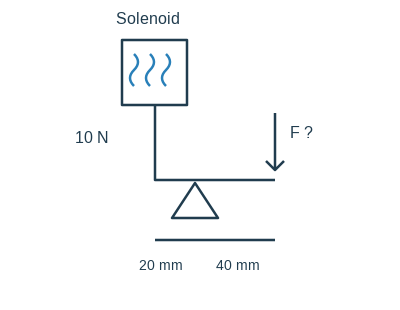
MechatronicsIntermediate
A solenoid and a lever
At one static position, an electric solenoid applies 10 N perpendicular to a lever, 20 mm from its pivot. The opposing load acts perpendicular at 40 mm. For an ideal balanced lever, what load force is supported?
Take challenge
References
Original explanations based on these educational references. Reviewed 23 November 2026.
All lessons