
Mechatronics/Advanced
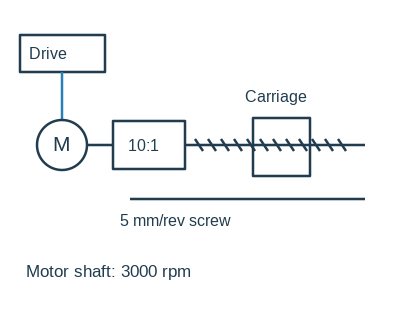
A speed reduction changes motor rotation before a screw converts it into linear travel. Use measured motor speed, the stated gearbox ratio, and screw lead. An electrical speed command or nameplate value is not automatically the actual shaft speed.
A pressure sensor’s electrical signal can represent a mechanical load. First convert voltage using its stated calibration; then calculate pressure difference times piston area. Gauge pressure is relative to ambient. Account for the pressure on the opposite side, and use SI units before multiplying.
Open-loop stepper commands do not measure actual position. Driver behavior, available torque, load, and transmission condition can affect motion. A short move does not uniquely identify a bad driver or a slipping coupler. Choose evidence that separates motor motion from load motion before deciding.
Put it into practice
MechatronicsAdvanced
Motor, gearbox, and screw
An electric motor’s shaft runs at a measured 3000 rpm. A 10:1 speed-reduction gearbox drives a screw with 5 mm lead per revolution. With no slip, what is the carriage speed?
Take challenge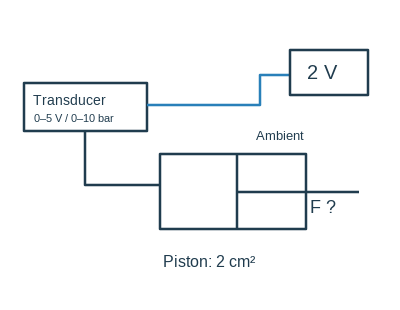
MechatronicsAdvanced
Voltage, pressure, and force
A linear pressure transducer outputs 0–5 V for 0–10 bar gauge. It reads 2 V at a cylinder with 2 cm² piston area; the opposite side is at ambient pressure. Ignoring friction and inertia, what net pressure force acts on the piston?
Take challenge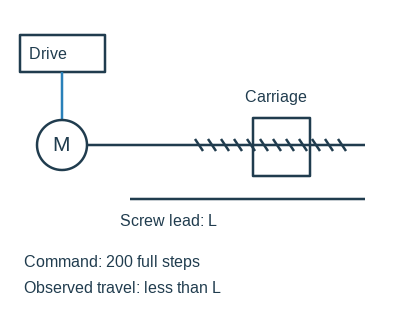
MechatronicsAdvanced
Commanded steps are not feedback
An open-loop stepper has 200 full steps per revolution and directly drives a screw. After 200 commanded full steps, the carriage travels less than one screw lead. No shaft, coupling, load, or current evidence is available. What can we conclude?
Take challenge
References
Original explanations based on these educational references. Reviewed 23 November 2026.
All lessons