
Mechanical/Advanced
In an ideal machine, input work equals output work. A reduction in required input force comes with greater input movement distance. Real friction and deformation add losses.
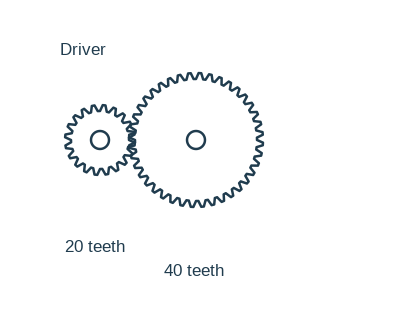
Two externally meshing gears rotate in opposite directions. Their tooth-count ratio sets their speed ratio. If a 20-tooth driver turns a 40-tooth driven gear, the driven gear rotates at half the driver speed. In an ideal steady transmission, its torque is doubled.
In an ideal pulley arrangement with a load supported by two equal-tension vertical rope segments, each segment supports half the load. You must pull twice the rope distance to raise the load a given distance.
Put it into practice
MechanicalIntermediate
A reduction pair
A 20-tooth driver meshes externally with a 40-tooth driven gear. The driver turns clockwise at 600 rpm. How does the driven gear turn?
Take challenge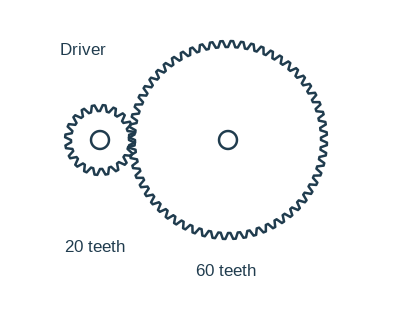
MechanicalAdvanced
Trade speed for torque
An ideal, lossless 20-tooth driver supplies 2 N·m to a 60-tooth driven gear at steady speed. What is the driven torque?
Take challenge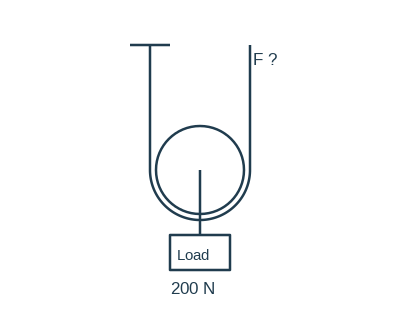
MechanicalAdvanced
The rope-distance trade-off
An ideal pulley supports a 200 N load on two vertical equal-tension rope segments. To lift the load 0.5 m, what effort and pulled rope distance are needed?
Take challenge
References
Original explanations based on these educational references. Reviewed 23 November 2026.
All lessons